An Explanation of Daniel’s Dreams and What They Mean Today
Can a dream given more than 2,500 years ago tell us something about the world we are living in today?
I recently watched a teaching by Alan Parr, who produces Bible-teaching videos on YouTube. I believe he is one of the best Bible teachers I have listened to when it comes to taking difficult subjects and explaining them in a way that ordinary people can understand.
One of his discussions dealt with the Book of Daniel and, in particular, the dream of King Nebuchadnezzar in Daniel Chapter 2.
The more I listened and compared it with Scripture and history, the more it got my attention.
Nebuchadnezzar's Dream
In Daniel 2, King Nebuchadnezzar has a troubling dream. He demands something extraordinary from his wise men: he doesn't simply want them to interpret the dream. He wants them to tell him what he dreamed and then explain what it means.
That's an important part of this story.
It would be easy for someone to hear a king describe a dream and then come up with an interpretation that sounds impressive. Nebuchadnezzar wasn't allowing that.
Daniel prayed to God, the mystery was revealed to him, and Daniel was able to tell Nebuchadnezzar both the dream and its meaning.
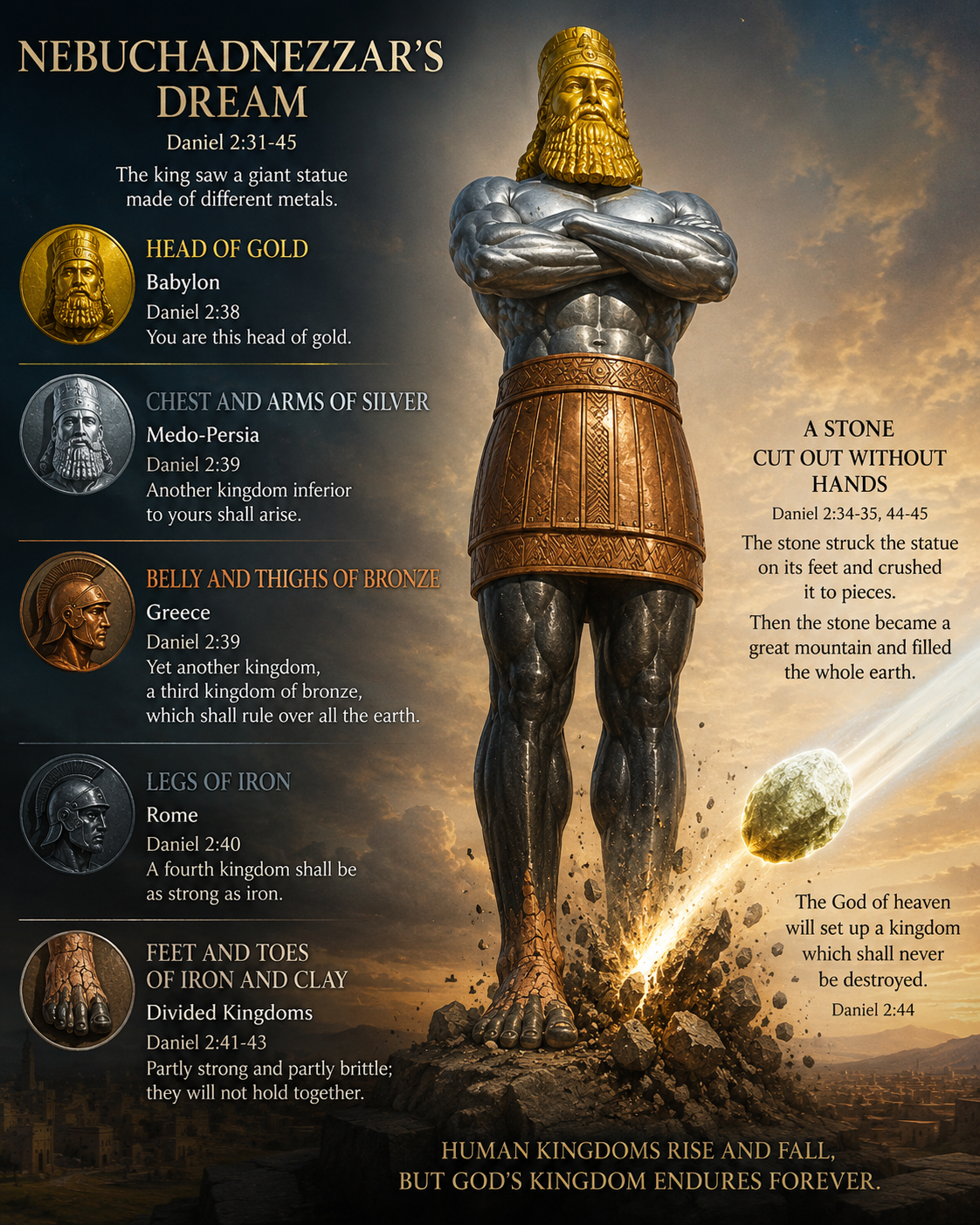
The king had seen an enormous statue.
The statue had:
A head of gold
A chest and arms of silver
A belly and thighs of bronze
Legs of iron
Feet and toes made partly of iron and partly of clay
Then something remarkable happened.
A stone that was not cut by human hands struck the statue at its feet. The entire statue collapsed and was crushed. The stone then became a great mountain.
Daniel explained that the stone represented a kingdom established by God—a kingdom that would ultimately overcome the kingdoms of men and would never be destroyed.
The Head of Gold — Babylon
Daniel doesn't leave us wondering about the first kingdom.
He tells Nebuchadnezzar directly:
“You are that head of gold.” — Daniel 2:38
Nebuchadnezzar ruled the Babylonian Empire.
But Babylon wasn't going to last forever.
Daniel told him that another kingdom would arise after his, followed by another and then another.
This is where history becomes fascinating.
Silver — Medo-Persia
The chest and two arms of silver have traditionally been understood as the Medo-Persian Empire.
Babylon eventually fell to the Medo-Persian Empire, just as Daniel had said that an inferior kingdom would follow Babylon.
Daniel lived to see the beginning of this transition, but the prophetic picture extended far beyond Daniel's lifetime.
Bronze — Greece
The bronze portion of the statue is traditionally identified with the Greek Empire.
This brings us to Alexander the Great.
Alexander conquered an enormous territory with remarkable speed and established Greece as the dominant world power.
Daniel's later visions become even more interesting because Daniel 8 actually identifies Media and Persia and then Greece by name.
That is one reason I believe it is important to read these chapters together rather than looking only at Daniel 2.
Iron — The Roman Empire
Next came the legs of iron.
The traditional interpretation identifies this kingdom with Rome.
Iron is an interesting description because the Roman Empire became an extraordinarily powerful military and political force. Rome conquered and controlled enormous portions of the known world.
But then we arrive at the part of Nebuchadnezzar's statue that I find particularly interesting.
The Feet of Iron and Clay
The statue eventually reaches its feet and ten toes, which are made from a mixture of iron and clay.
Iron is strong.
Clay is brittle.
And the two do not bond together well.
Daniel describes a kingdom that possesses strength but is also divided and fragile.
Many Christians who study biblical prophecy believe this portion of Daniel's prophecy ultimately points beyond ancient Rome toward events that have not yet been completely fulfilled.
There are different Christian interpretations concerning exactly how and when these events will take place. I don't believe we should pretend that every detail is completely settled when Bible-believing Christians themselves have debated some of these passages for generations.
But I do believe we should pay attention.
Then Comes the Stone
This may be the most important part of the entire dream.
The statue represents human kingdoms rising and falling.
Gold disappears.
Silver disappears.
Bronze disappears.
Iron disappears.
Every human empire eventually comes to an end.
But the stone is different.
Daniel says:
“The God of heaven will set up a kingdom which shall never be destroyed.” — Daniel 2:44
For Christians, this ultimately points to God's kingdom and the victory of Jesus Christ.
Governments change. Nations rise. Nations fall. Leaders come and go.
God's kingdom does not.
That, to me, is the real message behind all the prophecy.
A True Prophet Is Proven Over Time
Another thing that struck me about Daniel is the timing.
Daniel was describing kingdoms and events extending far beyond his own lifetime. He wasn't simply looking backward at history and explaining things that had already happened.
That matters.
The Bible warns repeatedly about false prophets, and we certainly have plenty of people today making predictions about what supposedly will happen tomorrow.
But Scripture gives us a test.
Deuteronomy 18:21–22 teaches that if someone claims to speak something in the name of the Lord and it does not come to pass, that word was not spoken by the Lord.
A true prophet isn't proven because he is charismatic, popular, has a large audience or tells people something they want to hear.
His words must stand the test.
When I look at Daniel, I can compare what he wrote with events that occurred over centuries of history.
That is powerful.
And if so much of Daniel's prophecy corresponds with events that happened long after these words were written, then I believe we ought to pay very close attention to the portions that may still concern our future.
Don't Take My Word for It
This may be the most important thing I can say in this entire article.
Don't take my word for it.
Don't simply take Alan Parr's word for it either.
And don't take the word of someone just because they have a television program, a YouTube channel, a church, a title or thousands of followers.
Get your Bible out and check it for yourself.
Start with Daniel 2. Then continue reading Daniel, especially Chapters 7, 8 and 9. Look at what Daniel actually says. Look at history. Compare Scripture with Scripture.
There are many false teachings in our world today. There always have been.
The safest place we can be is not following a particular man.
It is following the Word of God.
What Does Daniel Mean for Us Today?
I don't know exactly where we are on God's prophetic timeline, and I'm very cautious about anyone who claims to know the exact dates of future biblical events.
But I do know this:
Nebuchadnezzar's statue didn't stand forever.
Neither did Babylon.
Neither did Medo-Persia.
Neither did Greece.
Neither did ancient Rome.
The kingdoms of men rise and fall, but Daniel tells us that God's kingdom will ultimately stand forever.
That is what I took away from this teaching.
I was so impressed by the explanation and by what I found when comparing it with Scripture that I wanted to share it with those who read my blog.
Watch the teaching. More importantly, open your Bible and read Daniel for yourself.
Study it. Pray about it. Check the history. And don't be afraid to ask questions.
You may be surprised by what you find.
Have a blessed day.
— Michael Nobles