How Do I Buy a House That Is a Short Sale?
Can you really get a better deal by purchasing a short sale?
Yes, sometimes you can. In my opinion, a short sale can offer a better buying opportunity than a foreclosure, but you need patience, flexibility, and a real estate agent who understands how the process works.
Short Sales Are a Small Part of the Jacksonville Market
At the time I wrote this, there were 8,598 homes for sale in the Jacksonville metropolitan area, and only 132 of those were short sales. That's roughly 1.5% of the available homes.
That tells you something important right from the beginning: short-sale opportunities are out there, but there aren't very many of them. Finding one that is also in the right location, has the right floor plan, is in acceptable condition, and meets the rest of your needs can be difficult.
That's one reason I believe short sales can be especially interesting for investors. An investor may have more flexibility about the exact neighborhood, floor plan, or features of the property as long as the numbers make sense.
What Is a Short Sale?
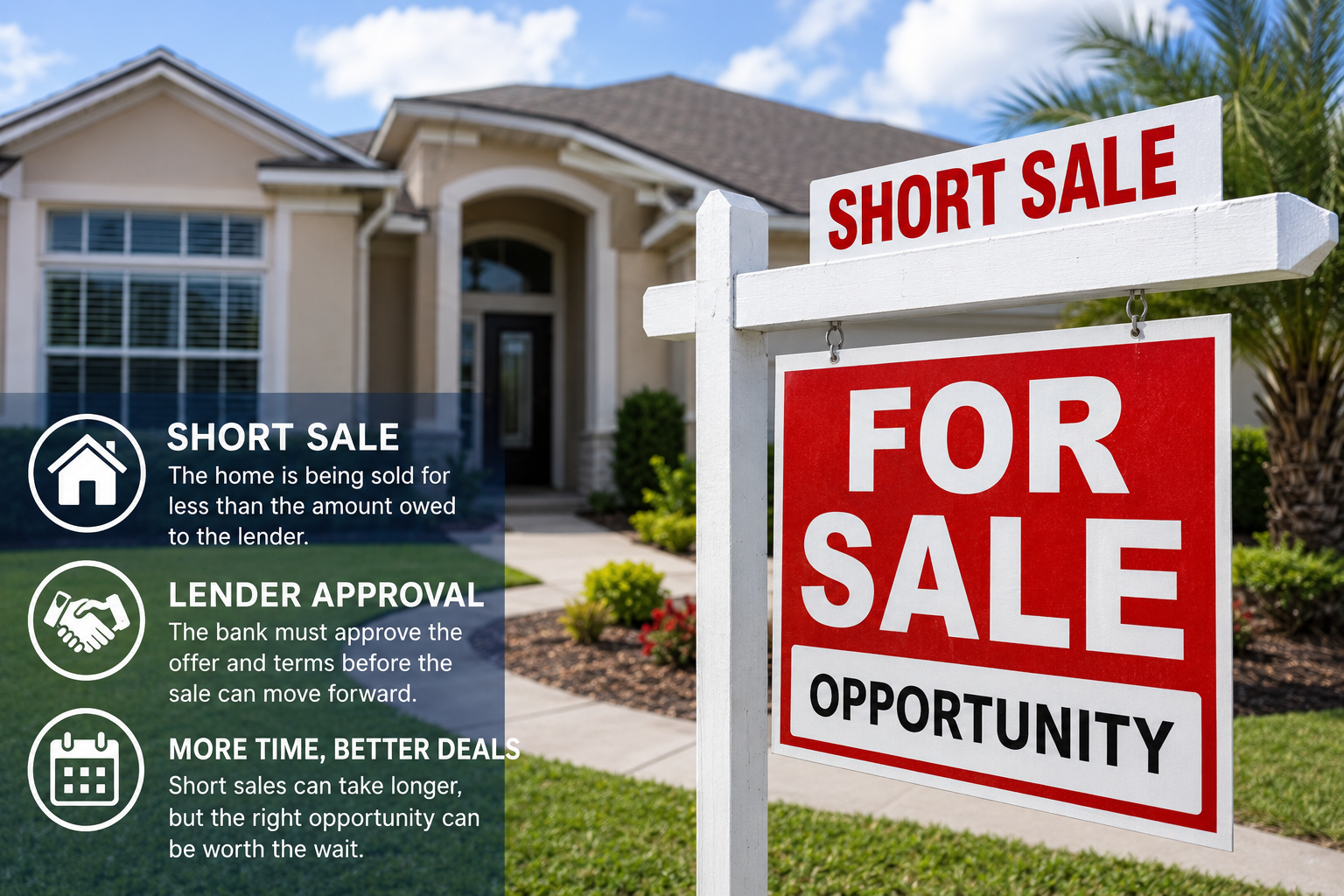
A short sale happens when a homeowner sells a property for less than the amount necessary to satisfy the mortgage and the lender agrees to the transaction.
For example, let's say a homeowner owes $300,000, but the property can realistically sell for only $250,000. If the lender agrees to accept the proceeds from that $250,000 sale and release its lien under the approved terms, the property may be sold as a short sale.
The important thing for a buyer to understand is that the homeowner isn't the only party involved in approving the transaction.
The lender or mortgage servicer has a major say in whether the short sale will be approved and under what terms.
Why I Prefer a Short Sale Over a Foreclosure
If I were looking for a distressed property, I would generally rather look at a short sale than a foreclosure.
Over the years, I've seen foreclosure properties where the previous owners became frustrated, moved out, stopped maintaining the property, or in some cases damaged it before leaving. That certainly doesn't happen with every foreclosure, but it does happen.
With a short sale, the homeowner may still be living in and maintaining the house while the transaction is being worked out. In my experience, there can be a greater sense of responsibility for the property because the homeowner is still involved in getting the house sold.
That doesn't guarantee the house will be in good condition. You still need to inspect it.
Who Actually Approves Your Short-Sale Offer?
This is one of the biggest differences between buying a short sale and buying a traditional home.
Normally, you make an offer and the seller decides whether to accept, reject, or counter it. With a short sale, an agreement with the homeowner is only part of the process because the lender or servicer must also approve the short-sale terms.
The lender may handle the process directly, or other parties may be involved in processing or negotiating the short sale.
This can make the transaction considerably slower than purchasing a traditional home.
In my experience, you may wait around 30 days or longer for a decision, depending on the lender and circumstances. I would never go into a short sale expecting a guaranteed 30-day answer. Some move faster, while others can take considerably longer.
What Happens If the Bank Doesn't Like My Offer?
The lender is looking at the property's value, the mortgage balance, expected expenses, liens and how much money it expects to receive from the sale.
If your offer doesn't produce an acceptable result, the lender may reject it or require different terms before approving the short sale.
This is why I tell buyers not to look at a short sale exactly like a normal real estate transaction.
You might make what appears to be a perfectly reasonable offer, and the seller might be willing to move forward with it, but that doesn't necessarily mean the lender will approve the transaction.
Watch for Additional Short-Sale Fees
Another thing buyers need to investigate is whether there are any additional fees connected with the transaction.
I've seen situations where a third party was involved in handling or negotiating the short sale and an additional fee was requested. Depending on the transaction, those costs can become substantial.
Don't assume that every short sale has an additional fee, because most may not. But find out before making your offer who is being paid, how much they are being paid, and who is responsible for paying it.
Some loan programs specifically allow buyers to pay certain short-sale processing fees or other obligations when properly disclosed and approved. Fannie Mae, for example, requires written disclosure and agreement among the appropriate parties for additional fees associated with acquiring a short-sale property.
Who Pays the Real Estate Commissions and Closing Costs?
This is another area where I don't like making blanket statements.
In many short sales, the lender approves real estate commissions and certain normal transaction expenses from the sale proceeds. However, the amount and allowable expenses depend upon the lender, loan program, approval and individual transaction.
For example, current Fannie Mae short-sale servicing guidelines permit customary real estate commissions up to certain limits, along with specified customary transaction expenses.
So don't automatically assume that a particular commission percentage or all of the buyer's or seller's closing costs will be paid. Those details need to be verified for the particular property.
Don't Skip the Home Inspection
Getting a good price doesn't make a house a good deal.
I recommend having the property properly inspected just as you would with another home—maybe even more carefully.
Some short-sale properties may be sold as-is, meaning you shouldn't assume that the seller or lender will make repairs simply because an inspection discovers problems. Freddie Mac's current short-sale requirements, for example, generally call for the sales contract to state that the property is being purchased in as-is condition, subject to certain financing exceptions.
You need to know what you're buying.
A house that appears to be $30,000 below market value isn't necessarily a bargain if it needs $50,000 worth of work.
What Happens to the Seller's Unpaid Mortgage Balance?
This is an area where sellers need professional tax advice.
Suppose the homeowner owes $300,000 and some portion of that debt is ultimately canceled as part of the short sale. Depending on the circumstances, canceled mortgage debt may be considered taxable income.
However, it is not as simple as saying that every dollar the lender doesn't receive automatically becomes taxable income.
The IRS provides exceptions and exclusions that can apply to canceled debt, including situations involving insolvency and bankruptcy. The federal exclusion for certain qualified principal-residence debt generally applies to debt discharged before January 1, 2026, or under a qualifying written arrangement entered into before that date.
A lender may also issue a Form 1099-C reporting canceled debt.
That's why I strongly recommend that a seller considering a short sale talk with a CPA or qualified tax professional before making decisions based on what they think the tax consequences will be.
As a real estate agent, I can help with the real estate side of the transaction. Tax advice needs to come from someone qualified to give it.
Is a Short Sale a Good Way to Buy Your Primary Home?
It can be, but you need to have some flexibility.
Remember my numbers from the beginning: only about 1.5% of the homes available when I took this snapshot were short sales.
If you're looking for a very specific home—with a certain school district, neighborhood, number of bedrooms, garage size, pool, floor plan and price range—you may have a difficult time finding all of those things in such a small group of properties.
And once you find one, you still have to be willing to wait through the lender-approval process.
If it's the right house and you're not in a hurry, that's fine. There can certainly be opportunities.
Short Sales Can Be Especially Interesting for Investors
In my opinion, this is where short sales can become particularly attractive.
An investor may be more interested in the numbers than whether the house checks every box personally. If the property is in a good location, can be purchased at the right price, and the cost of repairs still leaves room for the investment to make sense, waiting through the short-sale process may be worthwhile.
But don't let the words “short sale” convince you automatically that you're getting a bargain.
You still need to determine the property's market value, understand its condition, estimate repairs and know all of the costs involved in completing the purchase.
The Bottom Line
Buying a short sale isn't necessarily complicated for the buyer, but it can require considerably more patience than buying a traditional home.
You may have less certainty about timing, the lender has to approve the transaction, additional fees can sometimes be involved, and the property may be sold as-is. On the other hand, if you're patient and find the right property at the right price, I believe there can be some very good opportunities.
With only a small percentage of Jacksonville-area homes being offered as short sales, finding the right one is probably going to be the hardest part.
If you're considering buying a short sale in Jacksonville, Mandarin, St. Johns, St. Augustine, Fleming Island, Nocatee, Ponte Vedra Beach or the surrounding Northeast Florida area, I'd be glad to help you look at the numbers, understand the process, and determine whether a particular short sale makes sense for you.
Michael Nobles
CrossView Realty