Seller Beware of Certain Offers — Part 2
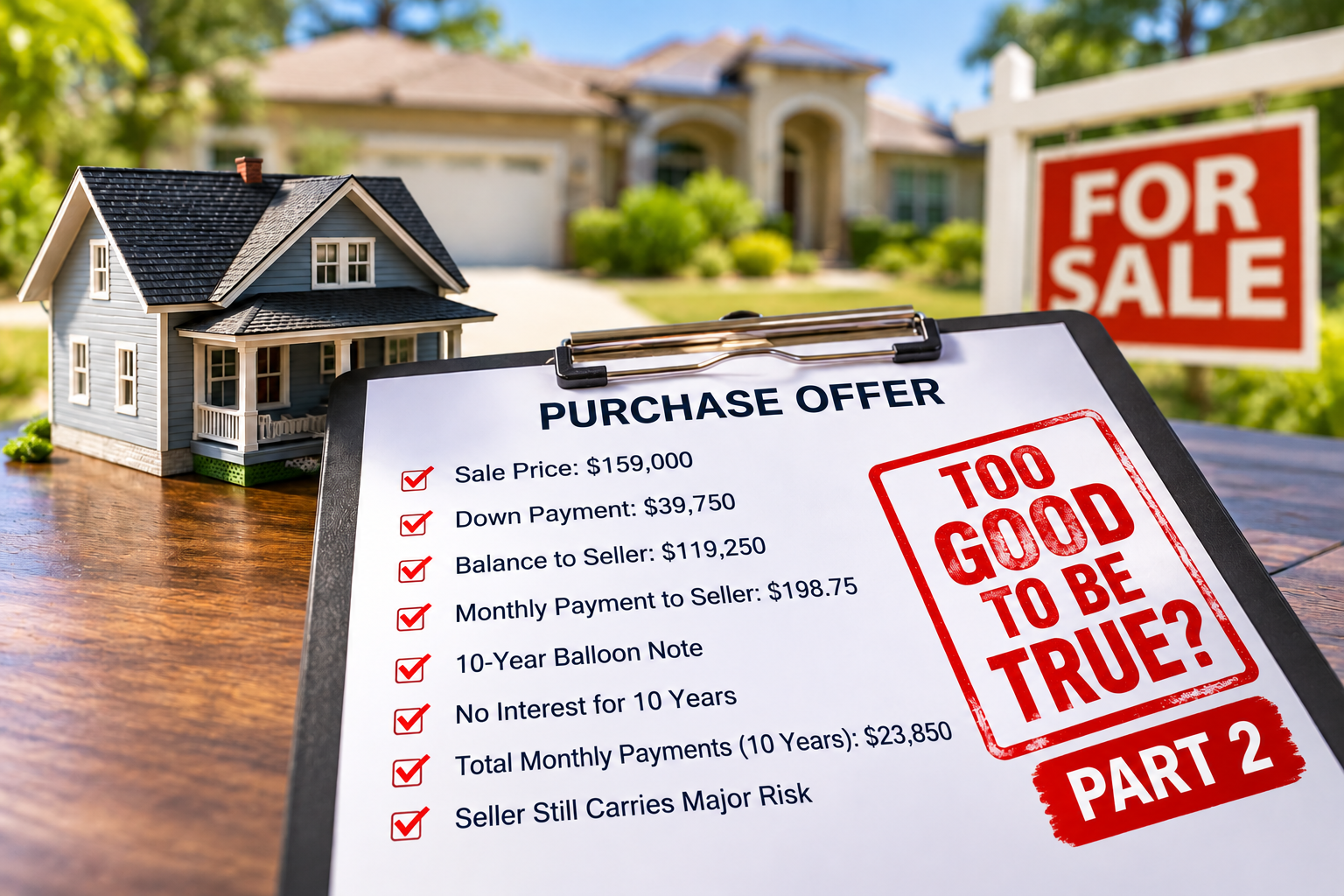
If a buyer offers you full price for your house, does that automatically make it a good offer?
No. Just like I discussed in Part 1, sellers need to look beyond the purchase price and understand when they are getting their money, how they are getting it, and what risk they are taking until they are paid in full.
Another Full-Price Offer That Caught My Attention
I recently received another offer on a different property.
The sale price was $159,000, and once again, the buyer was willing to pay the full asking price.
Sounds good so far.
But then you start reading the financing terms.
Here is essentially how the offer was structured:
Purchase price: $159,000
Down payment: $39,750
Balance financed by the seller: $119,250
Monthly payment to seller: $198.75
Balloon payment: 10 years
That $198.75 monthly payment immediately caught my attention.
What Would a More Traditional Payment Look Like?
I ran the numbers.
If the seller financed $119,250 at 6% interest, amortized over 30 years with the remaining balance due as a balloon after 10 years, the monthly principal-and-interest payment would be approximately:
$714.96 per month.
The offer I received proposed:
$198.75 per month.
That's a difference of more than $500 every month.
Over 10 years, $198.75 per month amounts to only $23,850 in payments before the balloon becomes due.
That's why a seller has to look beyond the words “full-price offer.”
What Interest Is the Seller Actually Receiving?
This is one of my biggest concerns with an offer structured this way.
If I'm going to ask my seller to carry $119,250 of the purchase price for 10 years, I want to know exactly how that money is being treated.
What is the interest rate?
How much interest accrues?
How much of each $198.75 payment goes toward principal?
How much goes toward interest?
Exactly how much will be owed when the balloon comes due?
Those answers need to be clearly spelled out.
A seller shouldn't have to guess.
And if the seller is effectively loaning someone $119,250 for 10 years, the seller needs to understand what they're receiving in return for allowing someone else to use that money for an entire decade.
Ten Years Is a Long Time
This is another part of the offer that concerns me.
A lot can happen in 10 years.
The buyer may live in the property.
They may rent it.
They may improve it.
They may refinance.
They may try to sell it.
The property's value could go up or down.
Meanwhile, the original seller is still waiting to receive a very large portion of the purchase price.
The buyer has put down $39,750, but the seller is carrying $119,250.
That's a lot of the seller's money tied up for a long time.
What Happens If the Buyer Resells the Property?
This is where sellers need to be particularly careful.
Suppose the buyer purchases the property and later finds another buyer willing to pay full price—or even substantially more.
What happens to the money still owed to the original seller?
Does the seller's loan have to be paid off when the property is sold?
Is the seller properly secured by a recorded mortgage or other appropriate security instrument?
Does the agreement contain a provision requiring the debt to be paid if ownership changes?
These are extremely important questions.
The original seller should not simply assume that because someone owes them money, their interests are automatically protected.
What If the Buyer Stops Paying?
Here's another question every seller should ask:
What happens if this buyer quits making payments five, seven or nine years from now?
The seller doesn't necessarily just get the house back.
Depending on how the transaction and security documents are structured, enforcing the seller's rights could require legal action and potentially foreclosure proceedings.
Now imagine that the property has subsequently been transferred to someone else.
That could make an already difficult situation considerably more complicated.
This is why the legal documents securing seller financing can be every bit as important as the purchase contract itself.
Full Price Is Only Part of the Offer
I want sellers to understand something from both Part 1 and Part 2 of this series:
Don't let the words “full-price offer” stop you from reading the rest of the contract.
A $159,000 offer isn't necessarily the same thing as receiving $159,000.
In this particular offer, the seller would receive $39,750 up front, then finance $119,250 for the buyer while receiving only $198.75 per month, with a balloon due 10 years later.
That's a very different financial arrangement from selling a property and receiving your proceeds at closing.
Seller Financing Isn't Necessarily Bad
Seller financing itself isn't automatically a bad thing.
There can be circumstances where seller financing works well for both parties.
But the terms have to make sense.
If I'm advising a seller considering an arrangement like this, I want them asking:
What interest rate am I receiving?
What is my monthly payment?
How much will I still be owed at the balloon date?
What secures my money?
What happens if the buyer defaults?
What happens if the buyer sells the property?
And most importantly:
When do I actually get all of my money?
Those questions matter much more than simply hearing that someone is willing to pay full price.
My Advice to Sellers
Creative financing can make an offer sound much better than it actually is if you only look at the purchase price.
Read every number.
Understand every payment.
Know exactly how much interest you're receiving.
Understand the balloon.
And make sure you know what protects you if something goes wrong.
When a seller is being asked to finance a substantial portion of a real estate transaction, I strongly believe the seller should have the appropriate professionals review the financing and legal documents before signing.
Final Takeaway
As I said in Part 1, the highest offer isn't always the best offer.
Sometimes a lower-priced conventional or cash offer that pays the seller at closing may be considerably more attractive than a “full-price” offer that leaves most of the seller's money tied up for years.
If you're selling a home in Jacksonville, Mandarin, St. Johns, St. Augustine, Nocatee, Fleming Island, Jacksonville Beach, Neptune Beach, Atlantic Beach or Ponte Vedra Beach and receive an offer with unusual financing terms, don't just look at the price.
Look at how—and when—you're actually getting paid.
Michael Nobles
CrossView Realty