Should a seller automatically accept a full-price investor offer?
Not necessarily. A full-price offer can look great on paper, but the price written on the original contract doesn't mean much if the buyer later tries to substantially renegotiate that price.
In Parts 1 and 2, I discussed offers that looked good until you examined the financing. In Part 3, I want to talk about something else I have seen: certain investor offers and what can happen after the seller accepts them.
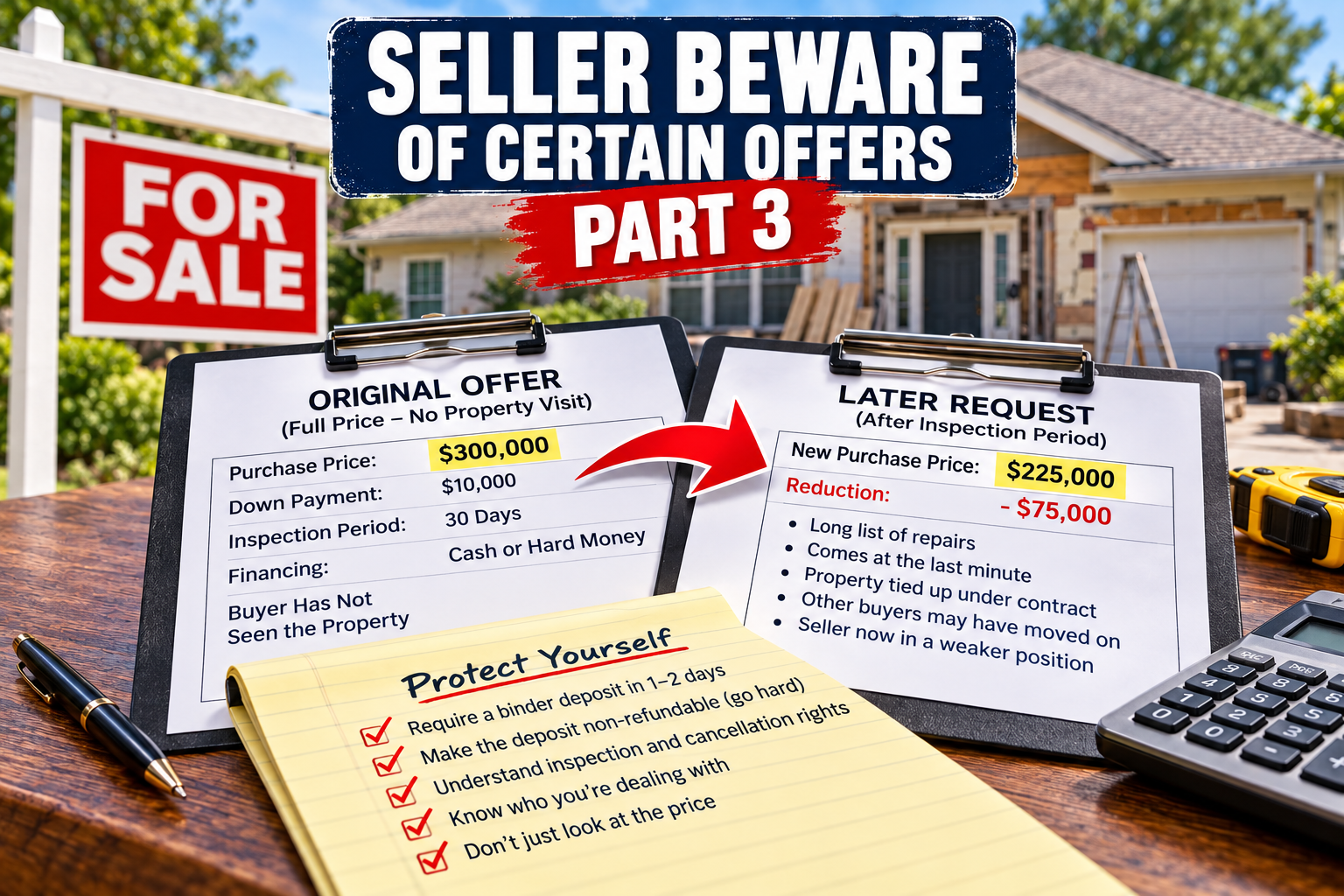
Let's Look at a $300,000 House
Let's say you have a house that, in its current condition, you believe is worth approximately $300,000.
The house needs some work. If that work were completed, maybe the property would be worth $350,000.
Then an investor comes along and offers the seller the full $300,000.
Sounds pretty good.
But here's something that makes me cautious:
The investor hasn't even looked at the property.
If someone hasn't walked through the house, looked at its condition, and evaluated what repairs are needed, how can they confidently determine that they're willing to pay the full $300,000?
That is something I want my seller to think about before accepting the offer.
What Happens After the Seller Accepts?
This is where I have seen problems develop.
The seller accepts the $300,000 offer.
The property goes under contract.
Other buyers see that it is no longer actively available.
Then the investor uses the inspection or due-diligence period to evaluate the property.
Instead of quickly coming back to the seller with concerns, I've seen situations where the buyer waits until very late in that period.
Then suddenly there's a long list of problems.
The buyer may say the roof needs work, the HVAC needs replacing, electrical or plumbing needs attention, or there are numerous other repairs.
And then comes the new number.
Instead of $300,000, the investor may say:
“Because of everything we've found, we need to be at $225,000.”
That's a $75,000 reduction from the original offer.
Was $300,000 Ever Really the Price?
That's the question sellers need to ask.
Was the original $300,000 offer truly what the buyer intended to pay, or was it simply the number necessary to get the property under contract?
I can't tell you what another buyer intended.
But when I see a buyer offer full price without even looking at a property and then later seek a substantial price reduction, I become very cautious.
To me, the original offer doesn't mean much if the buyer never intends to close at that price.
The Seller's Position Has Now Changed
This is one of the biggest problems I see with this strategy.
Before accepting the investor's offer, the seller had an active listing.
Other buyers could schedule showings.
Families could walk through the house.
Other offers could potentially come in.
Once the seller accepts the investor's contract, however, the situation changes.
The property may spend days or weeks under contract while other buyers move on to other homes.
Then, near the end of the inspection or due-diligence period, the investor comes back wanting a major price reduction.
Now the seller has a decision to make.
Accept the lower price?
Or reject it and put the house back on the market?
What Happens When the House Goes Back Active?
This is another concern sellers don't always think about.
When a property goes under contract and then suddenly comes back on the market, some buyers may wonder:
“What happened?”
“Why did the contract fall apart?”
“Did the inspection uncover something seriously wrong with the house?”
There may be absolutely nothing unusually wrong with the property.
The first buyer may simply have tried to renegotiate the deal.
But other buyers don't necessarily know that.
That can create uncertainty around the listing, and sometimes that uncertainty can affect what another buyer is willing to offer.
Suddenly, the investor's lower price may start looking more attractive to a seller who simply wants to get the transaction completed.
That's exactly the situation I want to avoid.
How I Try to Protect My Sellers
When I'm dealing with certain investor offers, I pay very close attention to the binder deposit and the buyer's ability to cancel.
I generally want that deposit made within the first one to two days, and when appropriate and agreed to in the contract, I want the binder to become non-refundable, or “go hard,” as quickly as reasonably possible.
Why?
Because I don't want an investor tying up my seller's property for an extended period with very little financial risk to themselves.
If an investor agrees to purchase the house for $300,000, ties up the property, and later comes back wanting to pay $225,000, I want my seller to have the ability to say:
“No. That's not the deal we agreed to.”
The investor can certainly ask for a price reduction.
Anybody can ask.
But if the contract provides for a non-refundable deposit at that point and the buyer walks away without a contractual right to recover it, the buyer may risk losing that binder.
That gives the investor a reason to take the original offer seriously.
Of course, whether a deposit is actually refundable or forfeited depends on the specific contract, contingencies, deadlines, and circumstances. That's why these terms need to be clearly understood when the contract is negotiated.
Not All Investors Are the Same
I also want to make something very clear:
Not all investors are the same.
There are some very good investors out there who work hard to earn your business.
They look at the property.
They understand its condition.
They make a fair offer.
They communicate clearly.
And most importantly, they do what they say they're going to do.
I've worked with investors like that, and an investor can absolutely be the right buyer for a property.
My concern is with certain investors and certain types of offers where a high price appears to be used to get the property under contract, followed later by an attempt to substantially reduce that price.
So I'm not telling sellers:
“Don't sell to an investor.”
I'm saying:
Know who you're dealing with and understand the contract you're signing.
Investor or Family Buying the Home?
When two offers are reasonably comparable, I may have more confidence in a buyer who has actually toured the property, understands its condition, and genuinely wants to live there than an investor who offers full price sight unseen while retaining broad rights to inspect or cancel.
A family that has walked through the house has seen the older kitchen.
They've seen the flooring.
They've looked at the roof.
They've seen the things that need updating.
They're making their offer with some understanding of what they're purchasing.
That matters to me when I'm helping a seller evaluate the strength of an offer.
Price is important.
But the likelihood of actually closing at that price is important too.
Don't Just Negotiate the Price—Negotiate the Protection
This is probably the biggest lesson I want sellers to take from Part 3.
When evaluating an offer, don't look only at:
“How much are they offering me?”
Look at:
How much is the binder deposit?
When is it due?
When does it become non-refundable?
How long is the inspection or due-diligence period?
What rights does the buyer have to cancel?
Has the buyer actually seen the property?
Can the buyer demand repairs or renegotiate?
What happens if the buyer tries to reduce the price?
And what does the seller risk if the transaction falls apart?
Those terms can sometimes be just as important as the purchase price.
My Advice to Sellers
A $300,000 offer isn't necessarily a $300,000 sale.
The offer that matters is the one that actually makes it to closing.
If someone offers you full price without even seeing your property, don't automatically assume you've hit the jackpot.
Ask questions.
Look at the deposit.
Look at the inspection period.
Look at the cancellation rights.
Look at the buyer.
And make sure the contract gives you reasonable protection if that buyer tries to substantially change the deal later.
Final Takeaway
Parts 1, 2 and 3 of this series all come back to the same principle:
The highest offer isn't always the best offer.
Sometimes the best offer is the one with the strongest buyer, the cleanest terms, reasonable protections, and the greatest likelihood of actually closing at the agreed-upon price.
If you're selling a home in Jacksonville, Mandarin, St. Johns, St. Augustine, Nocatee, Fleming Island, Jacksonville Beach, Neptune Beach, Atlantic Beach or Ponte Vedra Beach and receive an offer you're unsure about, I'll help you look beyond the purchase price and understand what the rest of that contract really means.
Michael Nobles
CrossView Realty